Open Banking in the UK explained
What is Open Banking?



 Read time: 5 minutes
 Published: 1st June 2026


Open Banking was introduced to the UK in 2018, and as of December 2025, it’s estimated to have 16 million UK users.
What is Open Banking in the UK, when might it be used, and is it safe? thimbl lifts the lid on Open Banking and answers some frequently asked questions.
Open Banking meaning: what does ‘Open Banking’ mean?
What is Open Banking? Open Banking is a safe, secure procedure carried out by an authorised financial third party, such as a credit provider.
With your consent, Open Banking allows the third party to view your recent financial activity via your online bank account.
It’s a bit like when you’re asked to provide a bank statement, but rather than having to print the paperwork out, a company can view the information in real-time through your online bank account instead. Open Banking is a straightforward procedure that could save you time.
What is Open Banking used for?
Open Banking has a range of purposes.
With your consent, Open Banking could be used by:
- Money management apps and services, to gain an overview of your finances and help set up a personalised budget or savings plan.
- Savings and investment companies, to securely and efficiently move your money between your main bank account and your savings or investment account.
- Credit providers as part of their creditworthiness assessment. Open Banking is sometimes used alongside or as an alternative to a hard credit search. While a hard credit search focuses on your credit history, Open Banking takes your recent financial situation into consideration. This could be especially useful for people who have a history of poor credit but have recently managed their finances positively.
How does Open Banking work?
Open Banking is a straightforward procedure.
You’ll be prompted to log in to your online bank account and grant your chosen company access. From here, they’re able to see your transaction activity and get an understanding of your financial situation.
You get to choose who accesses your information, and you can withdraw your consent at any time. Remember, when logging into your online bank account, your password and PIN will not be shared with the provider.
Open Banking: what can they see?
What does Open Banking show?
If you grant a company access to your online bank account through Open Banking, they will be able to see:
- Your account details, such as the account name.
- Your current bank balance.
- Recent transaction history.
- Regular payments, including Direct Debits.
Does Open Banking show all transactions?
Yes, if you allow a company to access your online bank account via Open Banking, they will be able to view all your recent transactions, including incoming and outgoing payments.
Is Open Banking legal in the UK?
Yes, Open Banking is legal in the UK.
Is Open Banking safe?
Yes, Open Banking is safe.
If you’re asking, ‘is Open Banking safe?’, here are some facts that could help put your mind at ease.
- Open Banking uses bank-level security systems to help protect you and your finances.
- Only companies that are authorised and regulated by the Financial Conduct Authority (FCA) can register to use Open Banking.
- Any company that appears on the Open Banking Directory of regulated providers has had to prove their service is legitimate and secure.
- You decide who has access to your bank account, and you can withdraw your consent at any time.
- Your online banking password and PIN remain private and will not be shared.
- A company cannot take money from your account without your permission.
Before you authorise access to your online bank account, you may wish to check to see whether the company appears on the FCA register. You can do this using the FCA Firm Checker tool.
Which UK banks offer Open Banking?
The official Open Banking website has put together a list of regulated providers that support Open Banking.
Can I use Open Banking if I don’t use online banking?
No. In order to undergo an Open Banking check, you’ll need to use online or mobile banking.
Can I refuse Open Banking?
Open Banking is optional, and you don’t have to give access to your bank account if you don’t wish to. However, please be aware that refusing Open Banking could mean that you won’t be able to complete your application for certain products and services.
For example, if approved, to use your virtual thimbl Credit Card, you will need to undergo an additional security check using Open Banking. If you do not wish to use Open Banking, you won’t be able to use the virtual thimbl credit card.
Are you worried about your finances?
You can get free, confidential financial advice from StepChange, MoneyHelper, Citizens Advice, and National Debtline.

Page last reviewed: 1st June 2026
Page reviewed by: Harry Lawrance
You get all this with thimbl

Tap and go
Quick and easy contactless payments up to £100.

Secure banking app
Manage your credit card online, wherever and whenever you like, with the free mobile app.

A trusted service
Over 4,500 positive reviews from our customers.
48.9% APR Representative (variable)
Quick links

Worried about money?
If you're worried about the cost of living, need support with budgeting, or think you might need debt advice, StepChange could help. They offer free and impartial support and help hundreds of thousands of people every year to deal with their debts and take control of their finances.
To find out how StepChange could help you, take the free Money Health Check. It's quick and easy to complete, and will give you a personalised recommendation on what to do next.
Credit Builder Credit Card
Over 200,000 people have already been accepted for a thimbl Credit Builder Credit Card
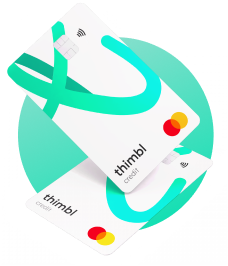
 Check if you're eligible with no impact to your credit scorePersonalised credit limit between £200 and £2,000
48.9% APR Representative (variable)
Meet the team

Head of Compliance

Head of Partnerships

Managing Director, thimbl

Marketing Manager, thimbl

Financial Content Writer
Frequently asked
questions
If you've got a question, you may just find the answer you're looking for here. If not, please visit our contact us page and get in touch.
What will my credit limit be?
You will always be made aware of any credit limit changes to any credit cards you have beforehand, and you do not have to accept a credit limit increase if you don't feel it's right for you.
What happens if I fail to make my repayments?
Missed payments will be reported to the credit bureaus, and your account will appear as in arrears. You will be charged a late fee, which is usually around £12. Your credit rating is also likely to decline as a result.
You should try to make your missed payments as soon as possible.
If you're struggling to keep on top of your repayments, you can find free, impartial advice from MoneyHelper, StepChange, Citizens Advice and National Debtline
If you want to know more about how credit cards work, you can read our blog.
Did you find this article helpful?
Let us know how we can be more helpful
Please leave your anonymous feedback to help us keep improving.
Need help or support?
Whether it's a question or you just need support, we're here to help.


